
Find and compare car, boat and RV storage near you, from open parking spaces to fully enclosed units.
Enter your ZIP code or city, choose the space size your vehicle needs, and compare monthly prices, specials and features at local facilities. Reserving online is free, and most reservations don’t require a credit card.
Search Vehicle Storage Near You
Pick a minimum space size, then sort by price or distance.
Looking specifically for RV parking? Browse RV storage on SpareFoot.
How Much Does Car, Boat and RV Storage Cost in 2026?
Vehicle storage runs from about $50 a month for an open parking space in a rural lot to $450 or more for a climate-controlled indoor space in a big metro. The two biggest price drivers are the type of protection you choose and the length of your vehicle, since many facilities price boat and RV spaces by the foot, often somewhere between $3 and $12 per linear foot per month.
Vehicle Storage Prices by Storage Type
| Storage type | Typical monthly cost | Protection | Best for |
|---|---|---|---|
| Outdoor uncovered | $50–$150 | Fenced, gated lot; no roof | Mild climates, frequently used vehicles, tight budgets |
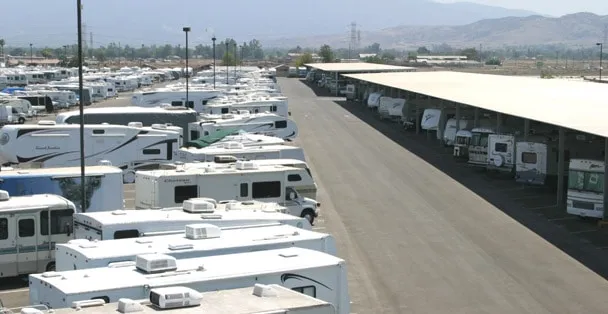
| Covered / canopy | $100–$250 | Roof blocks sun, rain, snow and most hail | Most boats and RVs, especially in sunny or stormy areas |
| Indoor enclosed | $150–$450 | Four walls and a locking door | Classic and collector cars, high-value boats and motorhomes |
| Climate-controlled indoor | $250–$600 | Stable temperature and humidity | Luxury rigs, wood boats, long-term storage in extreme climates |
Ranges reflect 2026 pricing published by storage operators and marketplaces. Rates in coastal metros such as Southern California, South Florida and the Northeast can run 30 to 60 percent higher, while much of Texas, the Plains and the rural South comes in lower. Search above to see real local prices.
What Size Storage Space Do You Need?
Measure your vehicle bumper to bumper, including the trailer tongue, hitch, outboard motor, bow pulpit, ladders and bike racks. Then add a couple of feet so you can walk around it. That total length, not the length on the registration, is what the space has to fit.
| Space size | Fits vehicles up to about | Common examples |
|---|---|---|
| 10×20 | 18 feet | Cars, SUVs, motorcycles, jet skis on a trailer, small fishing boats |
| 10×25 | 23 feet | Full-size pickups, bowriders and pontoons on trailers, pop-up campers |
| 10×30 | 28 feet | Travel trailers, Class B vans, larger ski and wake boats |
| Larger than 10×30 | 35 to 45+ feet | Class C and Class A motorhomes, fifth wheels, cabin cruisers |
Height matters too. If you’re considering covered or indoor storage, confirm the canopy or door clearance against your vehicle’s highest point, including the AC unit, antennas, a boat’s T-top or wakeboard tower, and the trailer’s height on its tires.
Outdoor vs. Covered vs. Indoor Vehicle Storage
Outdoor uncovered
The cheapest option and the easiest to find. Your vehicle is parked in a secured lot but exposed to sun, rain, snow and hail, so a fitted, breathable all-weather cover is a must. It works well for durable trailers and vehicles you use often.
Covered
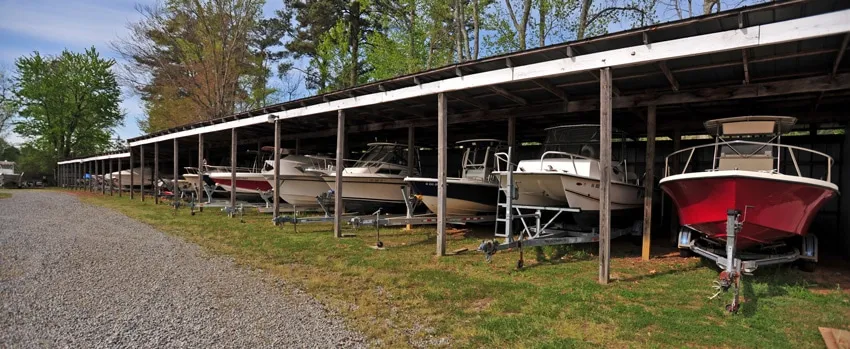
A roof over your space blocks the UV damage that fades paint, cracks rubber seals and dries out tires, plus most hail and snow load. For the typical boat or RV owner, covered storage is the best mix of price and protection.
Indoor enclosed
Four walls and a locking door protect against weather, pests, theft and vandalism. It costs the most, but it can pay for itself on a newer motorhome, a collector car or a boat you plan to keep for years.
What to Look for in a Vehicle Storage Facility
Price matters, but a cheap space that’s hard to get in and out of, or that isn’t secure, costs you in other ways. Check these before you reserve:
- Security: gated keypad entry, perimeter fencing, good lighting and video cameras that actually cover the vehicle area.
- Access hours: early launches and late returns need 24-hour or extended access, not a gate that opens at 9 a.m.
- Easy maneuvering: wide drive aisles and pull-through spaces make a big difference with a long trailer or motorhome.
- Clearance: covered and indoor spaces must clear your tallest point.
- Useful amenities: electric hookups for battery tenders, dump stations, air for tires, and wash-down areas.
- Location: a facility near your favorite lake, boat ramp or highway on-ramp saves time every trip.
- Paperwork: most facilities require current registration and proof of insurance, and some require the vehicle to be in running condition.
How to Prepare Your Vehicle for Storage
A little prep before storage prevents the most expensive problems: dead batteries, flat-spotted tires, frozen plumbing and rodent damage.
Cars
Wash and wax, fill the tank and add fuel stabilizer, change the oil if it’s due, inflate tires to the recommended pressure, and connect a battery tender or disconnect the battery. Use a breathable car cover and plug the exhaust against rodents, with a reminder note on the steering wheel.
Boats
Flush and drain the engine, stabilize the fuel, change the lower unit oil, and remove the drain plug if it’s stored out of the water. Clean and dry the interior to prevent mildew, take electronics home, and support the cover so water can’t pool. See our guide to preparing your boat for storage.
RVs and trailers
Drain the fresh, gray and black tanks and blow out or winterize the water lines with RV antifreeze. Empty and prop open the fridge, remove food, seal gaps where mice can get in, cover the tires against UV, and check the roof seals for cracks before they let water in.
7 Ways to Save on Vehicle Storage
Book before the rush
Boat and RV spaces fill up in the fall. Reserve early to lock in a rate and a space.
Measure precisely
Don’t pay for a 10×30 if a 10×25 will do. Measure the full length, then book the smallest space that fits.
Match protection to value
Covered storage protects most rigs well. Save indoor space for high-value or long-term storage.
Drive a little farther
Facilities outside the metro core are often much cheaper for the same space.
Ask about prepay
Many facilities discount rent when you pay six or twelve months up front.
Look for move-in specials
Online-only rates and first-month deals are common. Sort results by price to spot them.
Consider home options
If local rules allow, a metal carport at home can replace years of monthly storage bills.
Find your space now
Compare local car, boat and RV storage prices, then reserve free online.
Compare Vehicle StorageBudget before you book
Estimate what storing your RV will cost each month and where you can save.
RV Storage Cost CalculatorCar, Boat and RV Storage FAQs
How much does RV storage cost per month?
In 2026, RV storage typically costs $50 to $150 a month for an outdoor space, $100 to $250 for covered storage, and $150 to $450 or more for indoor enclosed storage. Longer motorhomes and high-cost metro areas sit at the top of those ranges.
How much does boat storage cost?
Dry storage for a trailered boat usually runs about the same as an RV space of the same length: roughly $50 to $150 outdoors, $100 to $250 covered, and more for indoor or rack storage. Marina slips and wet storage are priced separately and are often higher.
Can I store a car in a regular storage unit?
Yes. A 10×20 drive-up unit fits most cars and SUVs, and many facilities allow it as long as the car is registered, insured and in running condition. Some facilities don’t allow working on the vehicle or storing fuel cans inside the unit.
Is covered RV storage worth it?
For most owners, yes. Covered storage usually costs more than an open lot, but it blocks the UV and weather exposure that causes faded paint, cracked roof seals and dry-rotted tires, which can cost thousands to repair.
What size storage space do I need for an RV?
Measure your RV from bumper to bumper, including the hitch and any rear racks, and add about two feet. A 10×30 fits most travel trailers up to about 28 feet, while Class A and Class C motorhomes and large fifth wheels need spaces longer than 30 feet.
What documents do I need to store a vehicle?
Most facilities ask for a valid ID, current registration in your name, and proof of insurance. Some also require the vehicle to be operable and may ask for a copy of the title.
Can I store my boat or RV at home instead?
It depends on your city and HOA rules. Many neighborhoods restrict parking boats and RVs in driveways or on the street, which is one of the main reasons owners use a storage facility.
Pingback: Denver Self Storage: Find and Compare Storage Units (2026 Guide) - Easy Storage Search
Comments are closed.