

If you run a software company serving the moving industry, you already know the number that haunts your spreadsheet: **churn.**
You spend $1,500 to $3,000 acquiring each customer. Demos, onboarding calls, free trials, sales follow-ups. All of it just to watch them cancel within 6 to 12 months.
And here is the part that really stings: **it is almost never because your software is bad.** Your CRM works. Your dispatch tool works. Your estimating module works. The product is not the problem. Everything *around* the product is the problem.
Your customers are not software people. They are operators running trucks, managing crews, and dealing with customers who change their move date three times. When they cannot *feel* the ROI, when nobody checks in, when a leaner competitor undercuts you by 60%, they leave. And they rarely come back.
This article breaks down the four real reasons moving software companies lose customers in 2026, and what the smartest platforms are doing to fix each one with AI. If you are a founder, product leader, or head of customer success at a moving software company, this is for you.
Reason #1: Your Software Does Not Prove Its Value
Moving company owners think in dollars. Not features. Not workflows. Dollars. “Am I making more money with this software than without it?” That is the only question they care about. And if your product cannot answer it clearly, consistently, and automatically, you are already losing.
Most moving software dashboards show activity metrics: leads logged, calls made, emails sent. But activity is not value. **Value is: “How many of those leads turned into booked jobs? What was the revenue? How does that compare to last month?”** If the owner has to guess whether your tool is worth $299/month, the answer will eventually be “no.”
Without clear ROI visibility, your software feels like an expense rather than an investment. And expenses are the first thing to get cut when a slow season hits or a cheaper alternative shows up.
How AI Fixes It
**Automated ROI reports.** AI calculates the actual revenue attributed to your software every month and sends it to the owner without them asking. No more “I don’t think I’m using it enough.”
**Revenue attribution.** AI tracks the full journey from lead capture to booked job to completed move, connecting every dollar back to your system. The owner sees exactly how much money your platform made them.
**Benchmark comparisons.** “You are converting 23% of leads. Companies your size average 18%. Your system is outperforming by 28%.” This is the kind of message that makes cancellation feel irrational.
The bottom line: if your customer has to wonder whether your software is worth it, the answer is already trending toward “no.” AI-generated ROI visibility makes cancellation feel like throwing money away, because it literally is.
Reason #2: Your Retention Strategy Is Reactive
Be honest with yourself: what is your retention playbook? For most moving software companies, it looks something like this. A customer stops logging in, downgrades, or sends the dreaded “I need to talk about my account” email. A retention specialist calls, offers a discount, and hopes for the best.
By that point, the customer has already made up their mind. **The discount might buy a month, maybe two, but the underlying problems remain.** They were not getting value, they were not being supported, and now they feel like they are being bribed to stay. That is not retention. That is a slow goodbye.
The real problem is not that you cannot save churning customers. It is that you do not know they are churning until it is too late. By the time someone says “I want to cancel,” they decided three weeks ago. You are not fighting the cancellation. You are arguing with a decision that already happened.
How AI Fixes It
**Churn prediction.** AI identifies at-risk customers 30-60 days before they consider canceling, based on usage patterns, support tickets, and engagement metrics. You intervene while they still care.
**Automated health checks.** AI calls your customers quarterly to review their results, suggest optimizations, and ensure they are using the features that drive the most value. This is the account management experience that only enterprise clients used to get.
**Feature activation campaigns.** When AI detects a customer is not using a key feature, it triggers a personalized walkthrough rather than a generic email blast. The difference between “here’s a feature” and “here’s how this feature would save you $2,000/month.”
Reason #3: Cheaper Alternatives Are Popping Up Everywhere
Here is the uncomfortable truth that nobody in the moving software industry wants to talk about: **AI has made it dramatically cheaper to build software.** What used to take a team of 15 engineers and 18 months can now be prototyped by two people with AI coding tools in a matter of weeks. The barriers to entry have collapsed.
That means new competitors are emerging constantly. Leaner, cheaper, and laser-focused on one specific pain point. A moving company owner sees a tool that does dispatching better for $49/month and starts wondering why they are paying $299/month for a platform they only use half of. The instinct is to cancel your tool and stitch together three or four cheaper ones.
But here is where it gets interesting for you as a platform: **stitching platforms together does not solve the churn problem for the end customer. It multiplies it.** Now instead of one system that frustrates them, they have four that do not talk to each other. Leads live in one tool, estimates in another, dispatch in a third, follow-ups in a spreadsheet. Every handoff is a leak. Every integration is a point of failure.
This is actually your opportunity, but only if you recognize it. The companies that win are not the ones competing on price against a new $49/month tool every quarter. **They are the ones building a connected system** where the AI layer unifies everything so the moving company owner never has to think about which tool does what. That is the real competitive moat.
How AI Fixes It
**Unified intelligence layer.** AI connects CRM, dispatch, estimates, and follow-ups into a single system that shares context across every interaction. Your platform stops being “another tool” and becomes the operating system of the business.
**Tool consolidation analysis.** AI audits which subscriptions your customer is paying for and shows them how your platform already replaces three of them. This reframes the price conversation entirely.
**Future-proof architecture.** Instead of locking customers into a static roadmap, an AI-powered platform adapts as new tools and workflows emerge, absorbing what works, discarding what does not, without the customer lifting a finger.
Reason #4: You Are Selling Software When They Need a System
This is the meta-problem that underlies everything else. Most moving software companies position themselves as a tool: “We are a CRM.” “We are a dispatch platform.” “We are an estimating tool.” That positioning is a trap, because **tools are replaceable. Systems are not.**
When a moving company owner thinks of your product as a tool, they evaluate it against every other tool that does something similar. Price becomes the deciding factor. Features become a checklist. And the moment a cheaper, shinier alternative shows up, you are back to defending your subscription.
But when a moving company owner thinks of your product as *their revenue system*, the thing that captures leads, qualifies them, books estimates, follows up, dispatches crews, collects reviews, and generates referrals, switching becomes unthinkable. **The switching cost is not financial. It is operational.** Their entire business runs on you.
The difference between a tool and a system is AI. A CRM without AI is a database. A CRM with AI is a revenue engine that actively works to grow the business. AI is what turns passive software into an active partner, one that calls leads back, follows up on estimates, detects churn risk, and generates ROI reports automatically. That is the moat.
How AI Fixes It
**From tool to operating system.** AI agents handle the workflows between features: lead comes in, AI qualifies, books estimate, follows up, dispatches crew, collects review, asks for referral. The customer never touches another tool.
**Revenue-generating automation.** AI does not just organize data. It actively generates revenue by calling missed leads back, re-engaging cold quotes, and triggering post-move follow-ups. Your software stops being a cost and starts being a profit center.
**Operational lock-in through value.** When your platform runs dispatch, lead capture, follow-up, reviews, and referrals, switching is not about finding a cheaper tool. It is about rebuilding the entire operation from scratch. Nobody does that voluntarily.
The Real Cost of Churn
Let us put numbers to this. The average moving software company spends $1,500 to $3,000 to acquire a new customer (ads, sales team, demos, free trials). If that customer churns within 12 months at a $200/month subscription, you collected $2,400 in revenue against $2,000+ in acquisition cost. Your margin is razor thin, or negative.
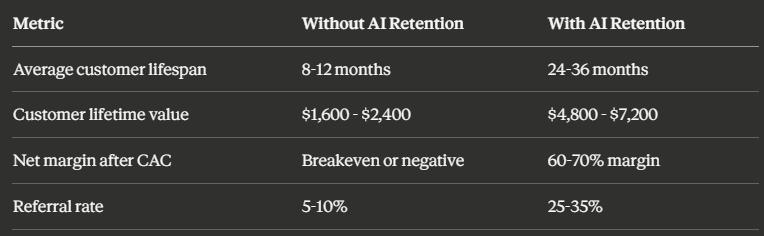
Extending customer lifespan from 10 months to 30 months does not just triple revenue. It transforms your entire business model. With higher LTV, you can afford to spend more on acquisition, build a better product, and hire better people. **Churn reduction is not a feature. It is your growth strategy.**
What the Best Moving Software Companies Are Doing Differently
The companies that are winning the retention game in 2026 are not just building better software. They are building better *systems around* their software. Here is what separates the platforms with 90%+ retention from the ones bleeding customers every quarter:
**1. Continuous value communication.** Monthly AI-generated ROI reports show exactly how much revenue the software contributed. The customer never wonders if it is worth it. They know.
**2. Proactive retention, not reactive discounts.** AI detects churn signals 30-60 days before cancellation and triggers personalized interventions, not “please stay” emails, but “here is a feature that would save you $2,000/month.”
**3. System positioning over tool positioning.** They do not sell “a CRM.” They sell a Revenue Operating System that captures leads, qualifies them, follows up, dispatches, and generates reviews, all in one connected experience.
**4. AI as the moat, not the feature.** AI is not a line item on the feature comparison chart. It is the invisible layer that makes everything work: calling leads, following up on estimates, generating reports, predicting churn. It is what makes switching unthinkable.
The Bottom Line
Moving software companies do not lose customers because their product is bad. They lose customers because the experience around the product, value visibility, retention strategy, competitive positioning, and system depth, is not good enough. AI does not replace your product. It fills every gap around it.
The companies that figure this out will dominate the next decade. The ones that keep treating churn as an inevitability will keep spending more on acquisition to replace the customers they keep losing. It is a treadmill that gets faster every year.
AI is not just a feature for moving software companies. It is the retention strategy. And in 2026, retention is the only growth strategy that matters.
Want to see how AI retention works in practice? We help moving software platforms integrate AI-powered retention, ROI reporting, and system-level automation. Book a Strategy Call to see what it looks like for your product.